Fishing in the English Channel (2011)
—
translation: Louis Shurmer-Smith
published on May 13, 2013
(2013)
| Number of fishermen (2011) Channel area: 9 801 French side: 6 095 English side: 3 706 | Quantity of fish landed (tons, 2011) Channel area: 209 219 French side: 158 578 English side: 50 641 | Most fished species (tons, 2011) Scallop Angler Sardine Mackerel |
| Number of vessels (2011) Channel area: 4 228 French side: 2 109 English side: 2 048 | Value of catches (€, 2011) Channel area: 522 219 684 French side: 427 814 000 English side: 94 405 684 | Most important species for sale (2011) Scallop Sole Norway Lobster European Seabass |
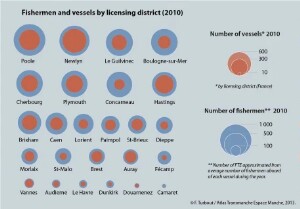
Of all the maritime activities practised in the Channel area, fishing is certainly one of the longest-standing. There are many ports of all sizes situated along the coast. With almost 9,800 sailors aboard some 4,200 ships, fishing continues to be a key activity for the local economy, even though it has undergone incessant restructuring and downsizing over the last 40 years.
The differences are sometimes stark between the two sides of the Channel and while there are more French than British sailors, this is mainly because the type of fishing practised is not the same. 60% of all the fishermen in the zone work in the Channel area and 40% fish in the open sea. These fishing units, which operate in the Seas west of Scotland, or the Irish Sea for example, call on larger crews over long periods.
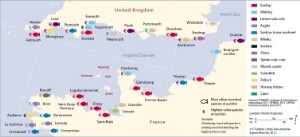
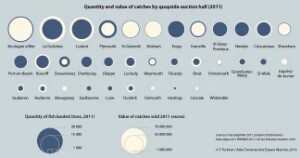
By its configuration, the Channel still harbours a wealth of diverse species. From Penzance to Dover and from Concarneau to Dunkirk, some 210,000 tons of catches are sold every year in the 35 fish markets in the zone. Boulogne is the largest fishing port in the Channel area with 28,000 tons of fish and crustaceans sold in 2011. In England, Plymouth is the leading fishing port with almost 14,000 tons of catches. There are differences in this regard too. Some species are more profitable than others and sell for more money for the same amount fished. Scampi, monkfish (anglerfish), seabass, sole and scallop shells are among the most profitable species. In Fécamp, fishermen can get more for sole than mackerel, even though more of the latter is fished. More generally, throughout the area, scallops are the most sold and the most profitable species.
Pressure has mounted considerably on the resource at the same time as diverse protection measures have been set up. Depletion of resources elsewhere and more difficult economic balances for fishing boat owners are prompting flotillas that did not come over recent decades to come and fish in the Channel. Adjustments are sometimes difficult.
This fishing, which has shaped populations and societies for centuries, is now in fierce competition with countless other commercial, tourist and industrial practices . Although the destruction of flotillas leads to a reduction in activity, a joint and coherent approach to managing the resource and activity can only help to maintain this vital sector for the Channel area.

|
Quayside auction hall
|
Quantity of fish landed 2011 (tons) | Value (€) | Quayside auction hall | Quantity of fish landed 2011 (tons) | Value (€) | Quayside auction hall | Quantity of fish landed 2011 (tons) | Value (€) | ||
|---|---|---|---|---|---|---|---|---|---|---|
| Audierne | 978 | 5 962 000 | St-Guénolé-Penmar'ch | 13 262 | 26 903 000 | Brixham | 12 666 | 26 879 000 | ||
| Boulogne-sur-Mer | 27 904 | 55 541 000 | Loctudy | 3 117 | 11 567 000 | Newlyn | 8 604 | 22 303 000 | ||
| Brest | 1 797 | 8 680 000 | Loguivy-de-la-Mer | 1 405 | 2 816 000 | Plymouth | 14 123 | 16 780 000 | ||
| Cancale | 268 | 823 000 | Lorient | 16 952 | 57 032 000 | Portsmouth | 1 567 | 2 562 000 | ||
| Cherbourg | 4 894 | 13 052 000 | Roscoff | 6 660 | 23 012 000 | Shoreham | 7 318 | 13 991 000 | ||
| Concarneau | 8 224 | 26 018 000 | Saint-Malo | 1 529 | 3 580 000 | Weymouth | 2 521 | 3 036 000 | ||
| Dieppe | 3 462 | 9 508 000 | Saint-Quay-Portrieux | 9 159 | 24 143 000 | Eastbourne | 920 | 2 183 000 | ||
| Douarnenez | 4 902 | 3 330 000 | Erquy | 11 849 | 31 463 000 | Looe | 916 | 2 666 000 | ||
| Dunkirk | 908 | 5 587 000 | Port-en-Bessin | 7 242 | 18 606 000 | Falmouth-River-Falmouth | 604 | 1 135 000 | ||
| Fécamp | 2 108 | 5 662 000 | Grandcamp-Maisy | 1 544 | 5 239 000 | Hastings | 273 | 807 000 | ||
| Granville | 11 255 | 18 558 000 | Megavissey | 927 | 1 886 000 | |||||
| Le Guilvinec | 17 985 | 65 824 000 | Whitstable | 202 | 178 000 |
Note []
To cite this document:
Turbout, F. (2013). Fishing in the English Channel (2011). Atlas Transmanche.